
General · Root Canal

Root Canal Treatment in Jamsil: Saving the Tooth Instead of Pulling It

When decay or injury inflames the nerve inside a tooth, a root canal removes the infection and keeps the tooth. A crown then protects it.

Location
#206, A-dong, Galleria Palace, 212 Olympic-ro, Songpa-gu, Seoul · 5-minute walk from Jamsil Station, Exit 4
Dentist
SNU School of Dentistry · prosthodontics-trained at Asan Medical Center, Dr. Byungwook Lee treats patients personally
Hours
Mon·Tue·Wed·Fri 09:30-18:30 · Sat 09:00-13:00 · closed Thu, Sun & holidays
Cost · Insurance
Root canal treatment is covered by NHIS · the crown afterwards is separate (varies by material) · confirmed after diagnosis
Booking · Parking
Book by phone +82-2-2145-4501 · 2 hours free parking at Galleria Palace

Galleria Dental Clinic provides root canal treatment a 5-minute walk from Jamsil Station (Exit 4) in Songpa, Seoul. Root canal (endodontic) treatment removes the inflamed or infected pulp, the nerve and blood vessels inside the tooth, then cleans and seals the canals so the tooth can be kept instead of extracted.
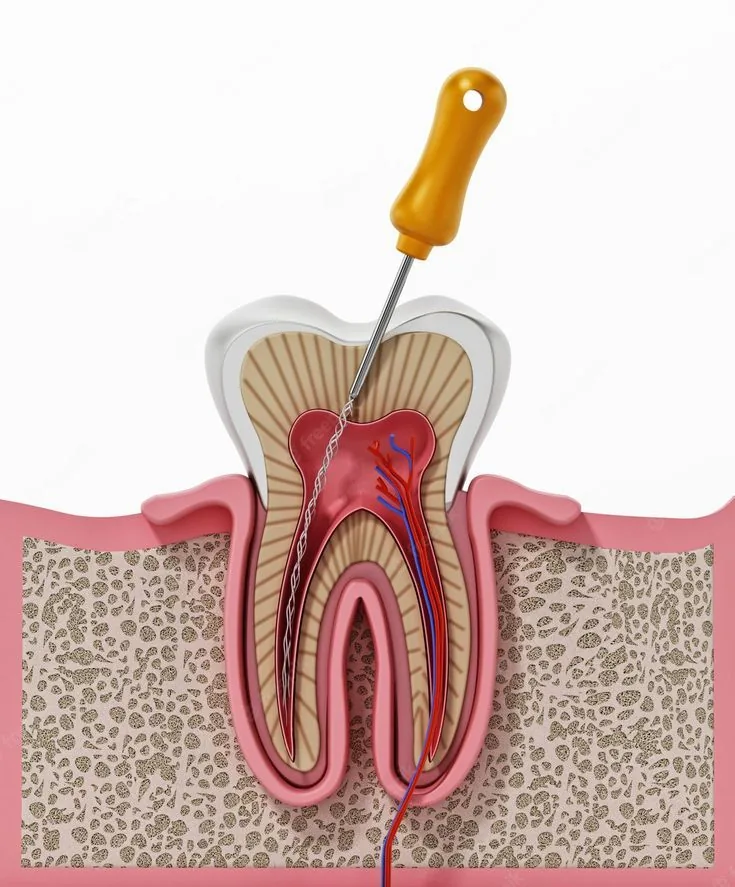
Cross-section illustration of root canal treatment removing infected pulp from inside the tooth
The infected pulp inside the root canals is removed and the canals are sealed.

Signs you may need a root canal

  • a throbbing toothache, even at rest, that is worse at night
  • strong or lingering pain with hot food or drinks
  • decay deep enough to reach the nerve
  • a broken tooth or an injury that exposed the nerve

Brief sensitivity to cold only is often a different problem that can be managed without a root canal. The dentist decides after an X-ray and exam.

How root canal treatment works

  1. Diagnosis: X-rays show the roots and the extent of inflammation
  2. Cleaning: the infected pulp is removed and the canals are disinfected
  3. Filling: the clean canals are sealed to prevent reinfection
  4. Crown: the weakened tooth is covered with a crown to protect it

How many visits, and how the cost is split

A root canal is done over several visits: the canals are cleaned, the inflammation is allowed to settle, and the tooth is sealed once it is free of infection. Molars with several roots or severe inflammation may need more visits; front teeth with a single root often need fewer. The treatment itself is covered by Korean national health insurance, while the crown placed afterwards is a separate, uninsured fee that depends on the material.

A tooth becomes brittle after a root canal, so finishing it with a crown matters. Here the same prosthodontics-trained dentist carries the tooth from root canal to crown.
For international patients: if you are enrolled in Korea's National Health Insurance (NHIS), insured treatments are billed the same way as for Korean patients, so please bring your residence card (ARC). Visitors without NHIS pay the full fee. See Fees & insurance.

※ Treatment fees and outcomes depend on each patient's oral condition, and this page does not guarantee results. Exact details are explained after an in-person exam and CT diagnosis.

FAQ

Root canal FAQ

How is root canal treatment done?
Diagnosis, removal of the infected nerve, disinfection of the canals, sealing with filling material, then a crown. Depending on the number of roots and the degree of inflammation, it may take several visits.
Does a root canal hurt?
Local anesthesia keeps the procedure itself comfortable. Severe acute inflammation can make anesthesia work less well, so coming in early helps. Mild discomfort between visits usually settles within a few days.
Do I need a crown after a root canal?
A root-canal-treated tooth is weaker and can crack, so a crown is recommended to protect it and keep it for the long term.
Is a root canal covered by insurance in Korea?
Yes. Root canal treatment is covered by National Health Insurance for enrolled patients. The crown afterwards is a separate fee that depends on the material. Patients without NHIS pay the full fee.
If a root canal fails, do I have to get an implant?
Not necessarily. Retreatment or apical surgery to save the tooth is considered first. Extraction is an option only when the tooth cannot be kept, and results vary by tooth condition.

Keep your own tooth where possible

Toothache? Early diagnosis makes treatment easier.

Directions Call